By Amit & Animesh, Co-founders, Nuvika Technologies
This post will make some people uncomfortable. That’s the point.
If your company uses a managed service partner to run your cloud operations - and many companies do - there’s a structural problem with your cost optimization strategy that nobody talks about openly.
It’s not that your partner is bad at their job. It’s not that they’re deliberately overcharging you. It’s that the way their business model works creates a financial incentive that runs directly counter to your interest in reducing cloud costs.
Let’s walk through the math, the incentives, and what you can do about it.
How Managed Service Partners Get Paid
There are three common pricing models for managed cloud services:
Model 1: Percentage of cloud spend. The partner charges a management fee calculated as a percentage of your total cloud consumption - typically 5-15%. If your monthly cloud bill is ₹20 lakhs, the partner earns ₹1-3 lakhs per month in management fees.
Model 2: Resource markup. The partner resells cloud resources to you at a margin. They purchase Reserved Instances or Savings Plans at a discount and bill you at a higher rate, keeping the spread. Or they add a per-resource management fee on top of the provider’s list price.
Model 3: Tiered pricing based on environment size. The partner charges based on the number of resources managed, the number of subscriptions, or the overall environment complexity. Larger environments mean higher fees.
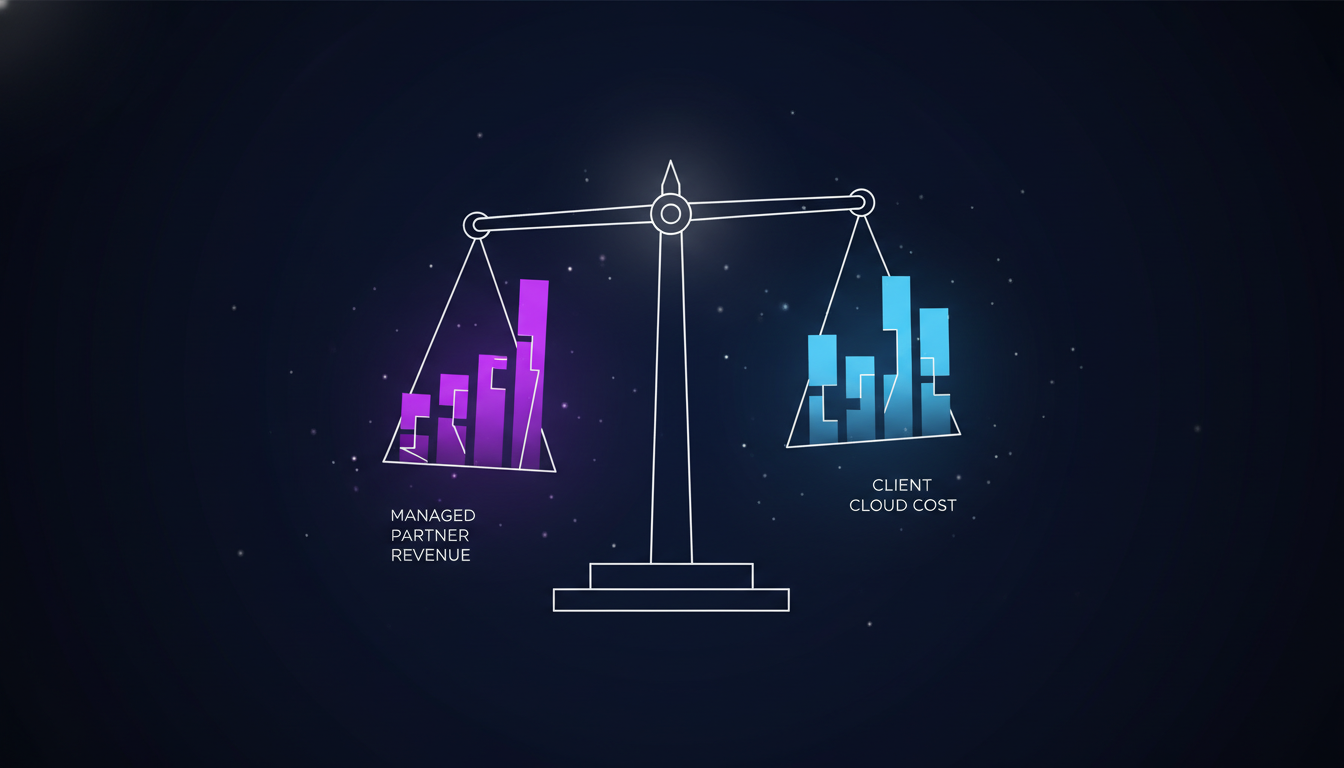
All three models share one fundamental characteristic: the partner’s revenue is positively correlated with your cloud spend.
When your cloud bill goes up, their revenue goes up. When your cloud bill goes down, their revenue goes down.
The Incentive Problem
Now imagine you ask your managed partner to optimize your cloud costs.
You’re essentially asking them to reduce their own revenue.
Let’s make this concrete. Suppose your partner manages a ₹25 lakh/month Azure environment at a 10% management fee - that’s ₹2.5 lakhs/month to the partner.
A thorough optimization could reduce your cloud spend by 25-30%. That takes your bill from ₹25 lakhs to ₹17.5-18.75 lakhs. Your partner’s revenue drops from ₹2.5 lakhs to ₹1.75-1.875 lakhs per month.
That’s a ₹6.25-7.5 lakh annual revenue reduction for the partner. From one client.
Will they do it? Some will, partially. They’ll find the easy, obvious wins - enough to show progress without significantly impacting their revenue. But will they hunt down the Azure Firewall that’s been running in your dev environment at ₹76,000/month with zero traffic? The DDoS Protection Standard plan at ₹2.5 lakhs/month protecting 3 public IPs? The HDInsight cluster that’s been forgotten for 6 months?
Finding those costs money. Reporting those costs revenue. The incentive structure works against thoroughness.
This isn’t malice. It’s just math.
“But Our Partner Does Cost Optimization Reviews”
Yes, many partners offer quarterly or annual cost optimization reviews. Some are genuinely useful. But consider the dynamics:
The partner controls the scope. They decide which resources to review, which recommendations to make, and which savings to highlight. You have no independent verification of whether they looked at everything.
The partner controls the benchmark. If they say “we saved you 15% this quarter,” how do you know the real opportunity wasn’t 30%? You’re trusting the same entity that profits from your spending to tell you how much you should be spending.
The partner has information asymmetry. They have full access to your environment. You see the monthly bill. They know which resources are idle, which are overprovisioned, which could be reserved. You’re relying on their disclosure.
This is the same reason companies hire independent auditors for financial statements. Not because the internal finance team is dishonest - but because independence removes the structural incentive to present things in a favorable light.
Your cloud costs deserve the same independent scrutiny.
The SLA Credit Problem is Even Worse
The managed partner conflict extends to SLA credit recovery - and here, the gap is even more stark.
When a cloud provider misses an SLA commitment, you’re owed credits. But filing a claim requires detecting the breach, gathering evidence, and submitting a case within a tight deadline.
Your managed partner could do this for you. But consider: the SLA credits come off your cloud bill. If the partner earns a percentage of your bill, SLA credits reduce the base on which their fee is calculated.
A ₹2 lakh SLA credit recovery on a 10% management fee costs the partner ₹20,000 in lost revenue. Not huge - but when the alternative is doing nothing and nobody notices, the rational economic choice is clear.
We’ve spoken to companies who’ve been with managed partners for 3-5 years and have never had an SLA credit claimed on their behalf. Not once. Across hundreds of monthly invoices and multiple provider outages.
The money was owed. Nobody claimed it. It disappeared.
What Independent Means
This is why we built Fintropy to be completely independent.
We don’t manage your cloud. We don’t provision resources. We don’t resell cloud services. We don’t earn a margin on your cloud spend. We have zero financial connection to how much you consume.
Fintropy earns when you save. Our interests are perfectly aligned with yours.
When our 497 rules scan your environment, every finding is a recommendation to spend less - not a threat to our revenue. When our SLA Recovery Engine detects a breach and auto-files a claim, the recovered credits are money back in your pocket. We have every incentive to find everything, report everything, and recover everything.
We sit on your side of the table.
What You Should Do
We’re not saying fire your managed partner. Many partners deliver genuine value in operations, security, and architecture. But we are saying this:
Get an independent second opinion on your cloud costs. Just like you’d get a second estimate before a major renovation, get an independent scan of your cloud environment that isn’t filtered through your partner’s incentive structure.
Ask your partner specific questions. “How many SLA credits have you claimed on our behalf in the last 12 months?” “What percentage of our resources did you include in the last cost review?” “Can we see the methodology?” Their answers will be revealing.
Separate operations from cost optimization. Your partner can be excellent at keeping your cloud running. That doesn’t mean they’re the right entity to minimize your cloud bill. These are different functions with different incentive requirements.
Verify with data, not trust. Trust is important in any partnership. But trust with verification is better. An independent scan that confirms your partner is doing a thorough job is a positive outcome for everyone. An independent scan that finds significant savings your partner missed is information you need.
If the independent scan finds nothing new - you’ve lost nothing and gained confidence in your partner. If it finds savings - you’ll know exactly how much has been left on the table. Either way, you win.
Fintropy runs 497 cost rules across AWS, Azure, GCP, Kubernetes, and VMware - completely independent of any cloud vendor or managed partner. Available now - sign up at fintropy.nuvikatech.com or get it on Microsoft Marketplace. Learn more at nuvikatech.com/Fintropy_Overview.html